I Bring Dough to Work
Sourdough bulk fermentation takes hours. My coworkers have hands. It works out.
Sourdough has a scheduling problem. Mix the dough in the morning, and it needs folds every 30 minutes for the first two hours of bulk fermentation. That's fine on a weekend. On a workday, it means either skipping the folds or bringing the dough with you.
I bring the dough with me.
It started as a practical workaround. I'd mix a levain the night before, build the dough at 6 AM, and by the time I got to the office the bulk was underway. I'd set the container on my desk, set a timer, and fold it myself. Nobody noticed for a while.
Then someone asked what was in the bowl.
What a fold actually does
A stretch and fold takes about 30 seconds. You wet your hand, grab one side of the dough, stretch it up until it resists, and fold it back over itself. Rotate the bowl 90 degrees. Repeat four times. That's one set.
What you're doing is building gluten structure without kneading. Each fold aligns the protein strands, traps gas, and strengthens the dough's ability to hold its shape through the rest of fermentation. Skip the folds and you get a slack, spreading loaf. Do them consistently and the dough transforms — from a shaggy mass into something smooth, elastic, and alive.
It's satisfying in a way that's hard to explain until you've done it. The dough pushes back. You can feel it getting stronger.
The office fold
Once people understood what was happening, they wanted to try it. Now it's a thing. Someone will wander over around 10 AM, ask if it's fold time, and take a turn. Engineers, designers, people from other teams who've heard about it. Some of them have never touched raw dough before.
The reactions are always the same: surprise at how sticky it is, then surprise at how quickly it cleans off a wet hand, then a kind of quiet focus as they work through the four sides. It takes maybe two minutes. People go back to their desks a little different.
I don't think it's about bread. It's about doing something physical and immediate in the middle of a day that's otherwise entirely abstract. You can see the result. You can feel whether you did it right. The dough doesn't care about your backlog.
The loaf
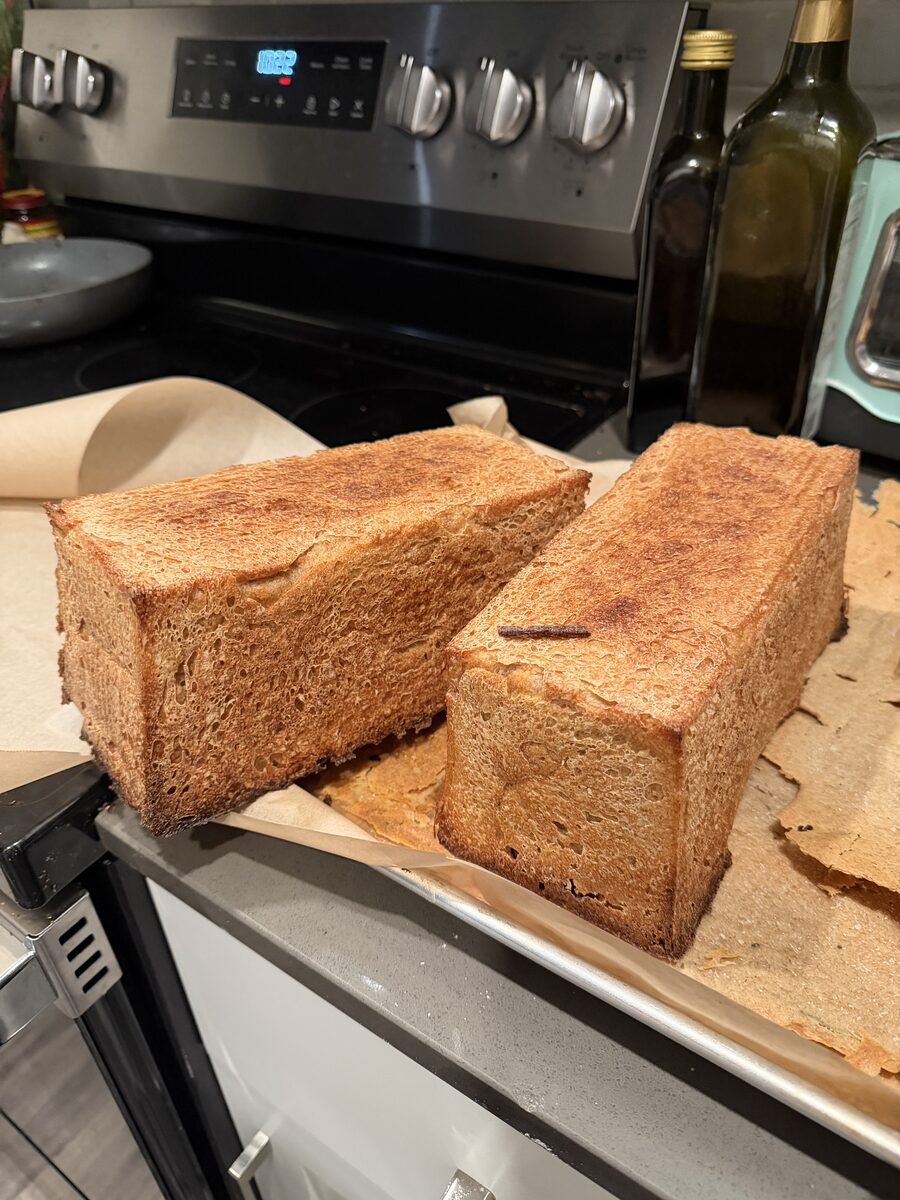
A pullman loaf, fresh from the oven — tight crumb, deep crust, baked in a lidded pan
This is a pullman loaf — baked in a lidded pan so it comes out with a perfectly square cross-section. The lid traps steam and keeps the crust thin. The crumb is tight and even, which makes it ideal for sandwiches. It's the bread I bring to work most often, because it slices cleanly and doesn't make a mess.
The dough that became this loaf was folded by at least three people who are not me.
Why it matters
Bread is one of the oldest things humans make together. For most of history it wasn't a solo project — it was a communal one. Grain was milled communally, dough was mixed in large batches, ovens were shared. The idea of bread as a solitary hobby is recent and a little strange when you think about it.
Bringing dough to work doesn't restore any of that. But it does make the process visible. People who've never thought about fermentation start asking questions. What makes it sour? Why does it need to rest? What happens if you don't fold it?
Good questions. The dough is a better teacher than I am.
If you want to try this at home — or at your own office — the sandwich loaf recipe is a good place to start. It's forgiving, it fits a standard loaf pan, and the fold schedule is easy to work around a morning of meetings.